
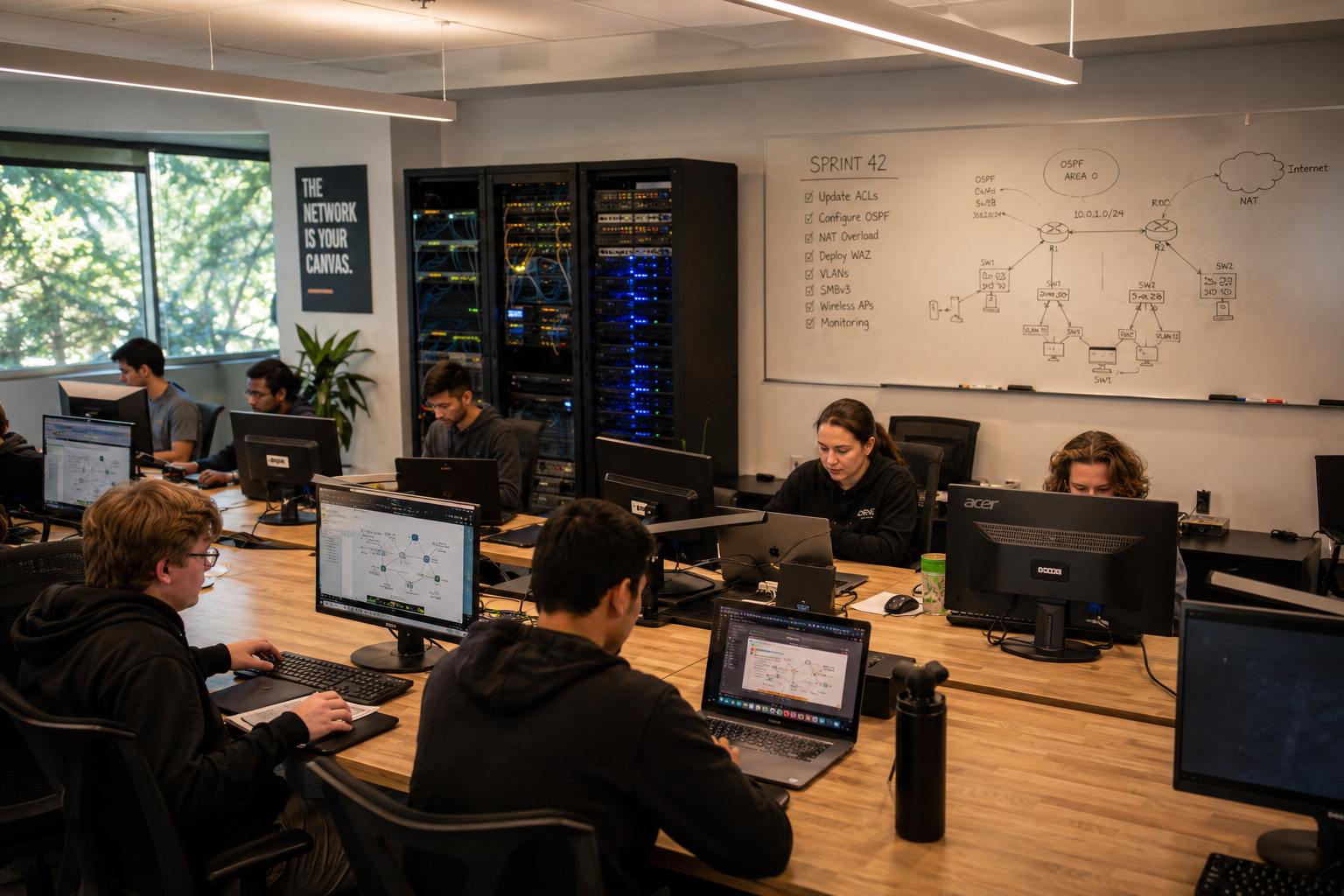
The most effective learning environment ever designed for career and technical education started not in a lab or a think tank, but in a state department of education in West Virginia.
In 2013, Kathy D’Antoni asked a simple question: what if a classroom functioned like a real business?
Twelve years later, that question has become the Simulated Workplace model — adopted across multiple states, referenced internationally, and quietly outperforming almost every other CTE delivery method on the metrics that matter: completion, certification, and employment.
The rest of higher education is still catching up to what a woman in Charleston figured out over a decade ago.
The Model
The Simulated Workplace model transforms CTE classrooms into actual business environments. Students don’t take courses. They hold job titles. They report to supervisors. They clock in, collaborate on real deliverables, and are held accountable for outcomes.
Not simulated outcomes. Real ones. A welding class fills orders. An IT class manages infrastructure. A healthcare class handles intake documentation. The classroom has a P&L, a chain of command, and consequences.
West Virginia’s model has since been adopted in Alabama, Kansas, Montana, North Carolina, and beyond. It has served students nationally and internationally. And it was designed specifically to address rural access barriers — the exact problem that most workforce development programs fail to solve.
Why It Works
The research this morning includes Harvard’s Project on Workforce case studies profiling four community colleges — Hudson County (NJ), Community College of Aurora (CO), South Texas College (TX), and Riverland Community College (MN) — that are building integrated educational ecosystems. Each leverages real-time labor market data, employer partnerships, and technology to create end-to-end pathways from enrollment to employment.
The Simulated Workplace model shares the same DNA but goes further. It doesn’t just connect students to employers. It makes the classroom indistinguishable from the workplace.
The reason this works is not complicated. Learning and doing are the same cognitive process when the feedback loop is immediate. A student in a traditional classroom learns a concept, then later — maybe — applies it. That gap is where knowledge leaks away. In a simulated workplace, you learn because you need to know right now. The customer is waiting. The server is down. The order has to ship.
There is no gap.
The Integration Insight
The CTE field has spent the last decade chasing integration — connecting curriculum, instruction, and assessment into unified systems. LMS implementations, xAPI standards, LTI 1.3, middleware layers. All the architecture that makes data flow between platforms.
But the Simulated Workplace model reveals something that all the middleware in the world can’t fix: integration isn’t primarily a technical problem. It’s an environmental one.
When the classroom is a workplace, the integration is automatic. The job role is the curriculum. The daily task is instruction. The deliverable is assessment. You don’t need REST APIs to connect these things because they were never separate to begin with.
Most institutions are trying to integrate silos. The Simulated Workplace model starts outside the silo entirely.
The Gap
Here’s what frustrates me: this model has existed since 2013. It has proven results. It scales across states and student populations. It directly addresses the access barriers that rural students face.
And most community colleges still don’t use it.
Instead, they invest in platform after platform — a new LMS, a new lab environment, a new assessment tool — without changing the fundamental structure of how the classroom operates. They buy technology to solve a problem that technology didn’t create.
The AIR June 2026 mini-brief on Competency-Based Education implementation identifies five core barriers to institutional transformation: integrating CBE into existing systems, faculty buy-in, adjusting teaching paradigms, regulatory alignment, and managing scale. Every single one of these barriers is addressed by the Simulated Workplace model — not because the model is sophisticated, but because it starts from a different premise.
It asks: what does the student need to be able to do? Then it builds the environment around that answer.
Most institutions ask: what curriculum do we have? Then they build the assessment around that.
The difference in starting point is the difference between learning and schooling.
What This Means
The data tells us that integrated ecosystem approaches work. The Harvard case studies prove it. West Virginia’s thirteen-year track record proves it. The market is signaling hard — 60% of IT employers report difficulty finding qualified candidates, 75% of jobs no longer require a four-year degree, and the skills-first movement is accelerating.
The institutions that figure out integrated, environment-first models will capture the next decade of enrollment and funding. The ones that keep buying platforms without changing structure will be teaching 2019 curriculum to 2026 students with 2008 tools.
The classroom that works like a real job has been possible since 2013. The question is whether we’re ready to stop treating it as an innovation and start treating it as the standard.